
- 2,408 Sold
- 120 Reviews
- 4.14
TrendX
TrendX is a systematic breakout and trend-continuation framework designed to participate in directional expansion following structural liquidity failure.
It evaluates multi-timeframe market structure, identifies meaningful containment boundaries, and engages only when those boundaries fail in conditions that have historically produced sustained movement. TrendX operates without discretionary interpretation, adapting to evolving volatility and structure in real time.
$2,499
- Strategy Type : Algorithmic, Trend Following, Momentum
- Fully Automated : Yes
- Market/Instruments : All Major Futures
- Trading Platform : NinjaTrader
- Product Type : Automated Trading System
- Skill Level : Beginner, Advanced, Professional
- Trading Style : Swing Trading, Trend Trading, Day Trading
TrendX is a systematic breakout and trend-continuation framework built around liquidity-driven market structure.
At its core, TrendX is designed to participate in directional movement that emerges after structural containment fails. It does not treat breakouts as visual patterns or isolated events. Instead, it interprets them as liquidity shock transitions moments when prior balance conditions break down and price shifts into expansion.
TrendX continuously evaluates market structure across multiple liquidity layers. A broader structural layer defines the dominant directional environment, while a local layer identifies the most relevant containment boundaries where liquidity accumulates. Opportunity is defined only when these layers align and containment fails in a way that historically produces continuation rather than decay.
Rather than predicting where price should go, TrendX responds to observable structural transitions. It filters out low-impact break attempts, avoids participation in structurally conflicted environments, and engages only when directional expansion occurs within supportive structural context.
The system is adaptive and self-learning, continuously evaluating how markets behave following similar structural transitions and adjusting its internal behavior to reflect historically tradable expansion patterns.
TrendX is not a pattern recognition tool, a discretionary trendline system, or a momentum-chasing indicator. It is a decision framework designed to systematically participate in post-containment expansion when liquidity behavior and structure align.
Core Operator Training
- TrendX — Master Operator Program
Recommended Framework Training
(Highly Recommended)
These training modules are strongly recommended to help you fully understand the logic, structure, and execution model behind TrendX, but they are not required to begin using the system.
- Algorithmic & Automated Trading Operator Program
- Microstructure & Liquidity Framework
Bonuses — Algo Trader Toolkit (Use As Needed)
These tools are optional analytical resources designed to help you explore, validate, and deepen your understanding as you grow. They are not required to use or operate TrendX.
- Monte Carlo Risk Engine
- Execution Cost & Slippage Analyzer
- Portfolio Diversification Risk Analyzer
- Asset Correlation Analyzer
- Cross-Asset Robustness Analyzer
- Investment Risk Visualization Guide
- Portfolio Performance Analyzer
- Walk-Forward Stability Dashboard
-
Participates Only in Structurally Meaningful Breakouts
Filters out low-impact moves and engages only when liquidity failure aligns with broader structure. -
Multi-Timeframe Structural Alignment
Uses concurrent liquidity layers to prevent trading against dominant directional conditions. -
Self-Learning Adaptation
Continuously evaluates how markets behave after structural transitions and adjusts to historically tradable expansion patterns. -
Volatility-Adaptive Framework
Automatically scales to each instrument’s behavior instead of applying fixed assumptions.
-
Eliminates Discretion
No subjective trendlines, no visual pattern interpretation — structure and engagement are mechanically defined. -
Designed for Post-Shock Expansion
Focuses on the portion of movement that follows containment failure, where directional drift historically emerges. -
Systematic Risk Governance
Defines protective boundaries immediately and manages exposure without emotional interference. -
Cross-Market Applicability
Operates across instruments and timeframes because it adapts to liquidity behavior rather than fixed parameters.
TrendX is built around a simple structural premise:
Markets rotate while contained.
They expand when containment fails.
Sustained movement tends to occur when that failure aligns with broader structure.
Everything the system does flows from that logic.
1. It Classifies Structure on Two Liquidity Layers
TrendX continuously evaluates market structure across:
A local liquidity layer that reacts faster and detects containment and failure
A macro liquidity layer that defines directional permission
These layers are volatility-adaptive.
They do not rely on fixed pip distances or arbitrary thresholds.
They determine whether current price movement is structurally meaningful or incidental.
2. It Identifies Containment Boundaries
TrendX tracks price areas where movement has been constrained:
Repeated interaction
Absorption behavior
Liquidity concentration
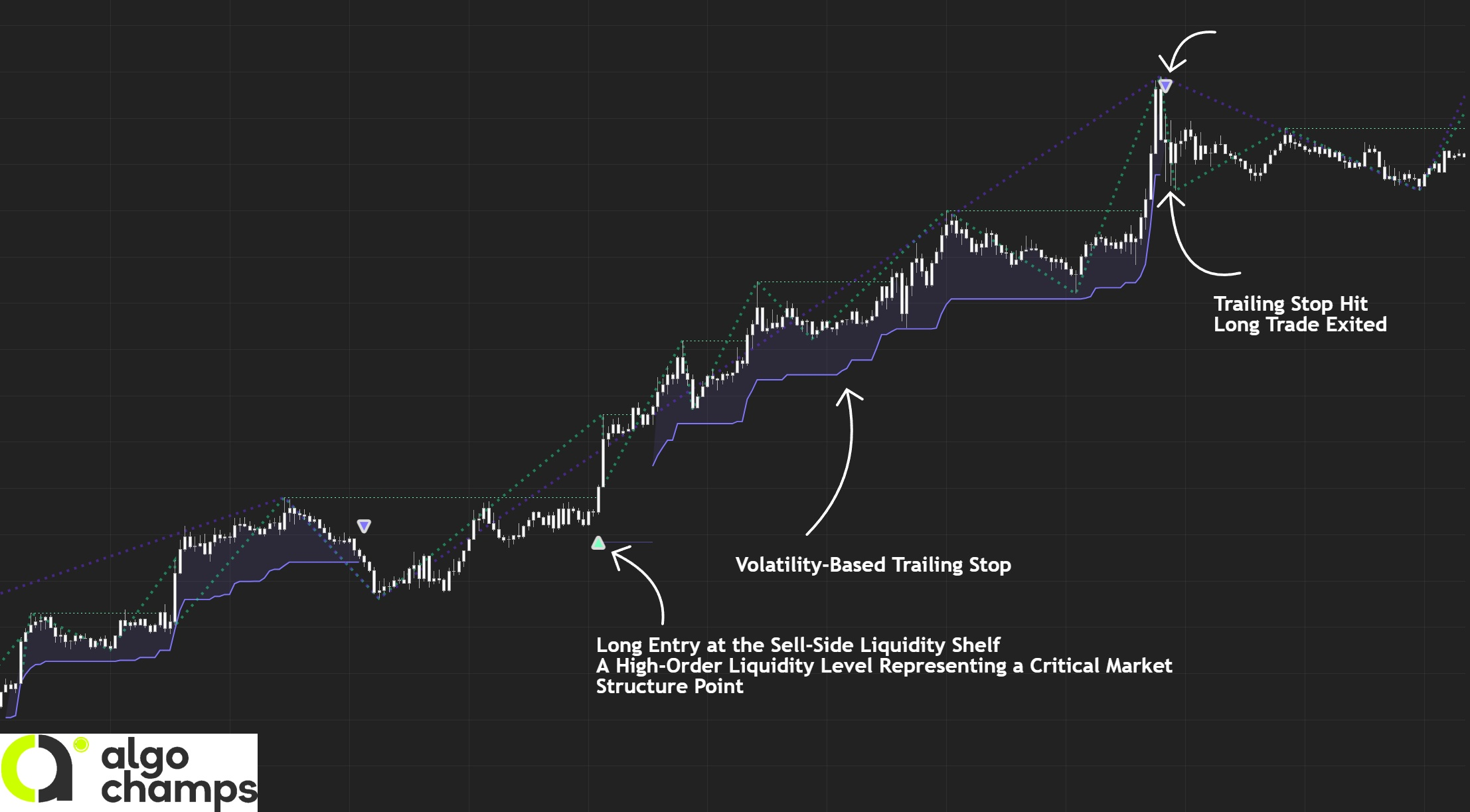
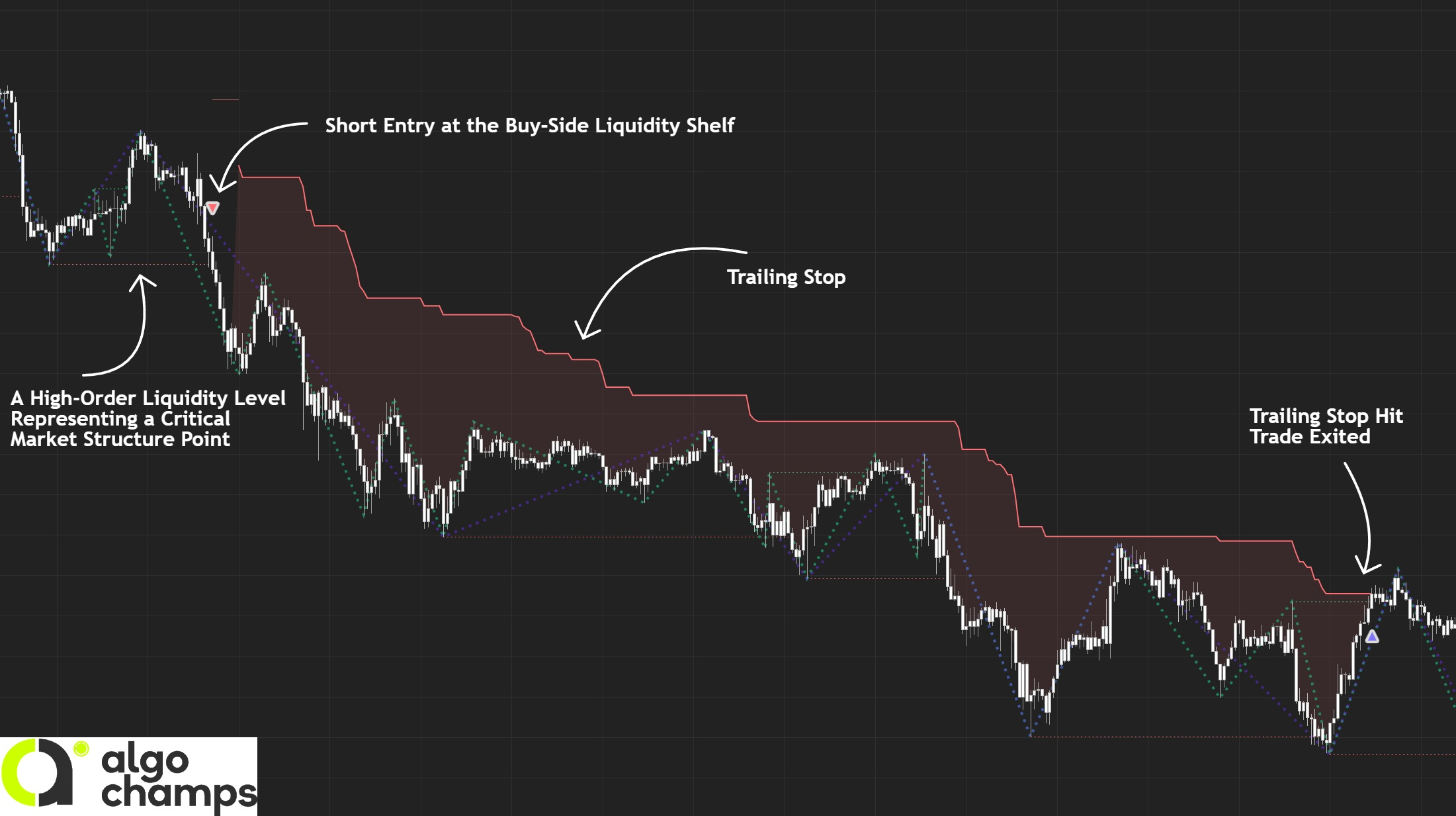
These areas function as liquidity shelves boundaries where price must overcome opposing participation to transition into expansion.
Not all shelves matter.
Only those that are structurally relevant to the current environment are considered.
3. It Waits for Structural Failure
TrendX does not predict breakouts.
It waits for observable containment failure:
Decisive violation of a liquidity boundary
Thinning opposing liquidity
Behavior consistent with post-shock expansion
Only once the shock is confirmed does execution become possible.
4. It Requires Structural Alignment
Before participating, the macro liquidity layer must permit continuation in that direction.
This prevents the system from engaging in local failures that statistically tend to decay.
Structure grants permission.
Failure creates opportunity.
Both must be present.
5. It Participates in Post-Failure Drift
Once engaged, TrendX participates in the expansion phase that follows structural containment failure.
It does not attempt to forecast endpoints.
It reacts to historically tradable expansion behavior and manages exposure systematically as price progresses.
TrendX is designed for traders who want a structured, systematic way to participate in trend environments without relying on discretionary interpretation.
It is built for traders who:
- Prefer rule-based execution over subjective chart reading
- Want a framework that reacts to structural liquidity shifts rather than predicting price
- Value consistency and repeatability over frequent trading activity
- Want trend participation filtered by higher-level market structure
- Prefer a system that adapts to volatility and evolving conditions instead of fixed setups
TrendX is especially suited for traders who want a professional, systematic approach to trend participation while removing emotional and discretionary decision-making from execution.
What You’ll Get
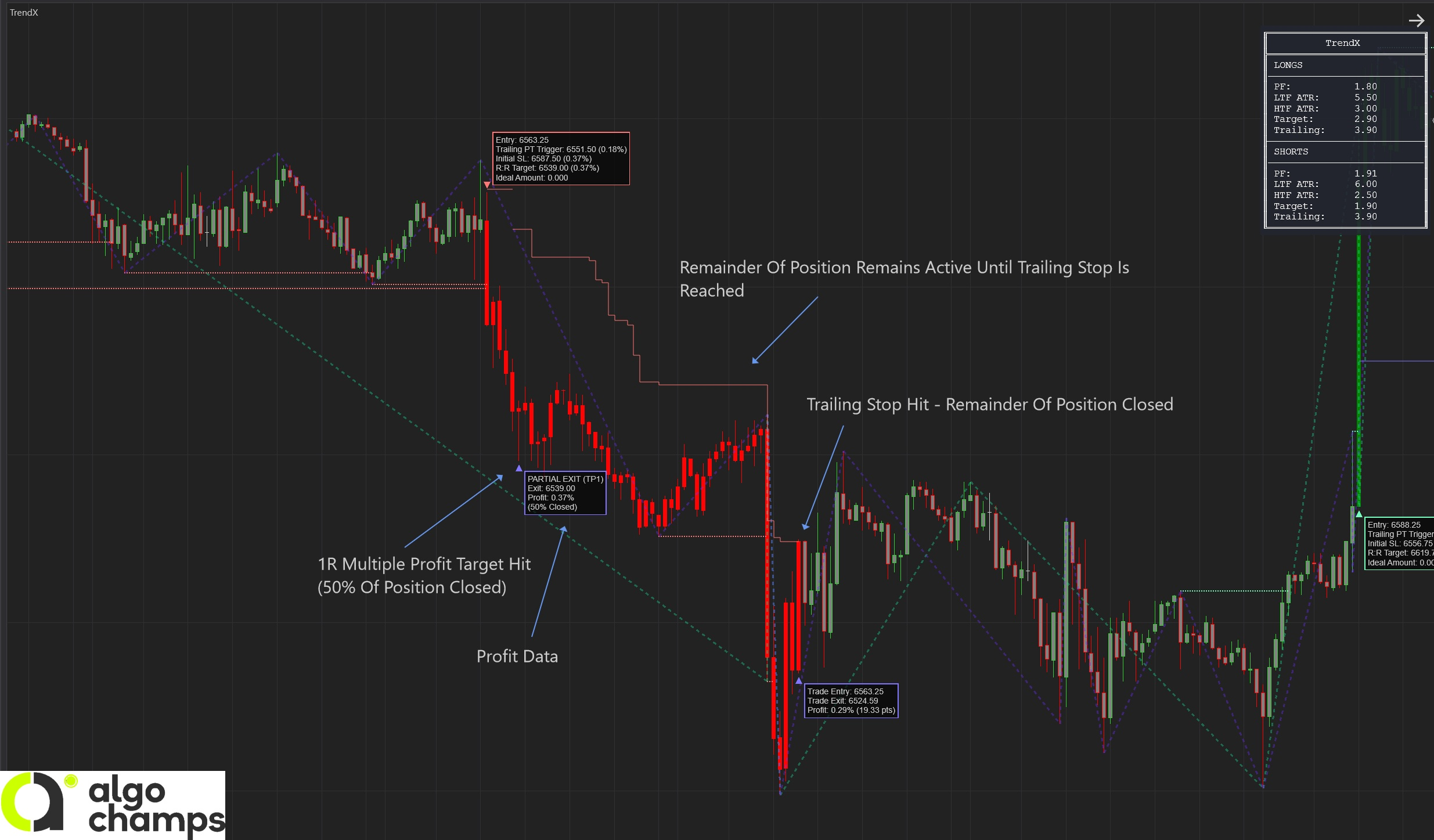
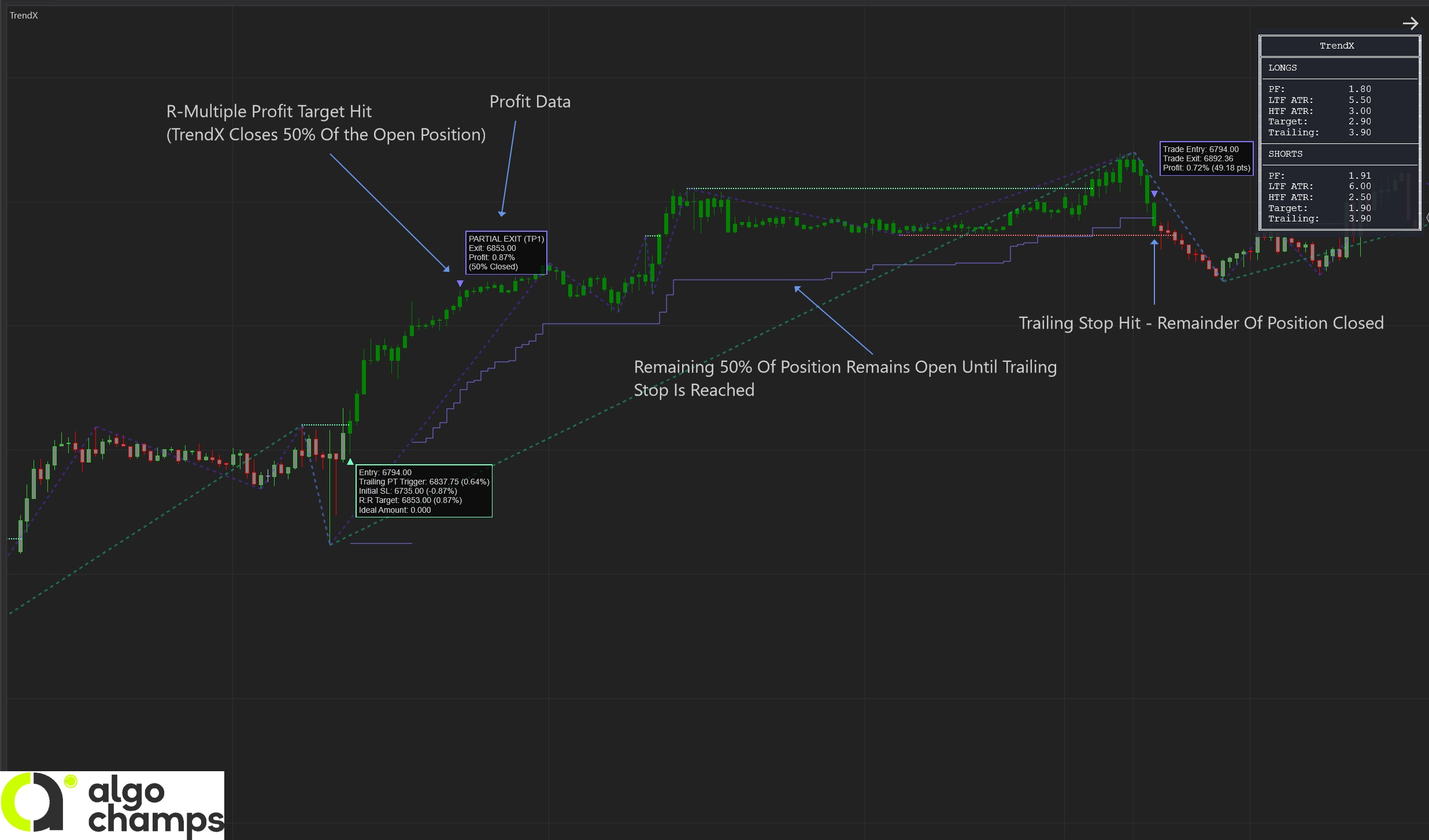
frequently asked questions
Does trend-following really work?
Yes, because markets naturally transition between balance and directional expansion. Price does not move in a straight line indefinitely, but when liquidity containment fails and participation becomes one-sided, sustained directional movement can emerge.
From a structural perspective, trends develop when liquidity is repeatedly absorbed in one direction and opposing participation fails to regain control. These phases are not random. They are recurring outcomes of how order flow interacts with market structure over time.
However, not every directional move persists. Trend-following is probabilistic. The objective is not to predict every trend correctly, but to participate when conditions resemble historically tradable continuation environments across many occurrences.
What is TrendX?
TrendX is a self-learning breakout and trend-continuation system built around liquidity structure and multi-timeframe market classification.
It identifies when structural containment fails, evaluates whether broader market structure supports continuation, and participates in post-breakout directional movement when conditions align.
TrendX is designed to respond to structural transitions rather than anticipate them.
How does TrendX decide when to trade?
TrendX evaluates markets through two core components:
- Liquidity-driven containment and failure
- Multi-timeframe market structure
Trades are considered only when:
- a meaningful containment boundary exists
- that boundary fails in a structurally valid way
- higher-timeframe structure permits continuation in the same direction
If structural alignment is absent, TrendX remains inactive even when local breakout activity appears aggressive.
What makes TrendX different from traditional trend-following systems?
Traditional trend systems often rely on static indicators or fixed rules.
TrendX differs by:
- treating breakouts as liquidity shock events rather than simple level breaks
- using volatility-adaptive structure classification instead of fixed swing logic
- gating participation using multi-timeframe structural alignment
- adapting execution behavior through self-learning components
- managing trades dynamically based on changing market conditions
The result is a system that reacts to structural context rather than rigid signals.
Does TrendX use machine learning?
Yes.
TrendX includes self-learning components that evaluate historical behavior and refine execution decisions over time.
However, machine learning is only one part of the framework. TrendX combines:
- liquidity-based structural logic
- volatility-adaptive classification
- rule-based execution constraints
- adaptive learning components
Learning improves execution within the framework rather than acting as a standalone prediction engine.
Can TrendX adapt to different markets and timeframes?
Yes.
TrendX uses volatility-aware structure classification, allowing it to scale across:
- different asset classes
- varying volatility environments
- multiple timeframes
The system adapts its structural interpretation to the market rather than forcing fixed assumptions across instruments.
Is TrendX fully automated?
TrendX can be used in multiple ways depending on deployment:
- as a decision-support framework for discretionary traders
- as a systematic strategy with automated execution
In both cases, the core logic remains the same: structural breakout participation within supportive market context.
Does TrendX come with anything else?
Yes.
TrendX is part of a complete educational and analytical ecosystem where understanding the system is just as important as using it.
The goal is not only to provide a trading system, but to provide the frameworks and mental models required to interpret what the system is doing and why it behaves the way it does.
Included is the full TrendX framework, which takes you from foundational concepts to practical execution. It explains:
- how liquidity-driven expansion events form
- how multi-timeframe structure creates directional context
- how breakout transitions develop into trend continuation
- how entries, trade management, and exits function as a unified lifecycle
- how probabilistic execution is applied across sequences of trades rather than individual outcomes
The focus is on understanding how TrendX thinks and how it should be interpreted in real market conditions.
TrendX also sits inside a larger learning ecosystem built to upgrade how traders think about markets and systematic execution.
Included are foundational frameworks such as:
Zero-to-Competent Algo Trading Framework
A complete shift toward systematic thinking, covering expectancy, risk, validation, robustness, and how professional algorithmic traders evaluate strategies.
Liquidity and Market Microstructure Framework
A deep structural explanation of how markets actually move, including liquidity formation, order flow behavior, containment, expansion, and why breakout events occur in the first place.
Beyond the frameworks themselves, the ecosystem includes 22 interactive analytical tools and simulators designed to turn abstract trading concepts into practical understanding. These tools allow traders to explore ideas like:
These tools allow you to explore ideas like expectancy, risk, robustness, market regimes, slippage, portfolio behavior, walk-forward stability, randomness, and system validation through hands-on experimentation rather than theory alone.
These are not passive resources. They are designed to help you internalize professional decision frameworks through experimentation and structured reasoning.
The objective is simple:
TrendX is not just something you run.
It is something you understand.
Related products
Related products


Trading systems built by championship-level traders. Verified performance. Real results. No gurus. No hype.
- Made in Liechtenstein.
Have more questions?
Fill out the form below and we’ll get back to you soon.
© 2026 AlgoChamps. All rights reserved.
Risk Disclosure
Futures and forex trading involve significant risk. It is not suitable for every investor. You can lose all your investment. You can also lose more than your initial deposit. Only use money you can afford to lose without affecting your financial stability. Only investors with sufficient risk capital should trade. Past performance does not predict future results.
Hypothetical Performance Disclosure
Hypothetical results have inherent limitations. These results do not guarantee that any account will achieve similar profits or losses. Actual results often differ from hypothetical examples. Hypothetical performance is created with the benefit of hindsight. It does not cannot be fully captured in any hypothetical example.
Testimonials
Testimonials on this website reflect individual experiences. They may not represent typical results. They do not guarantee future performance or success.
AlgoChamps adheres to all applicable vendor professional standards and compliance requirements in the jurisdictions where we operate.
Hypothetical and Simulated Performance Disclaimer
Hypothetical or simulated results have limits. They do not reflect actual trading, and no real trades were executed. Results may under or overstate the impact of market factors such as liquidity. Simulations use hindsight and historical data. No guarantee is made that any account will achieve similar profits or losses.
Any strategies, optimizations, or backtests shown on our platform, including those generated by our AI Backtesting tools, are hypothetical and for educational purposes only. Charts, equity curves, statistics, and alerts are illustrative. They do not indicate or guarantee future performance in live markets.
© 2026 AlgoChamps. All rights reserved.